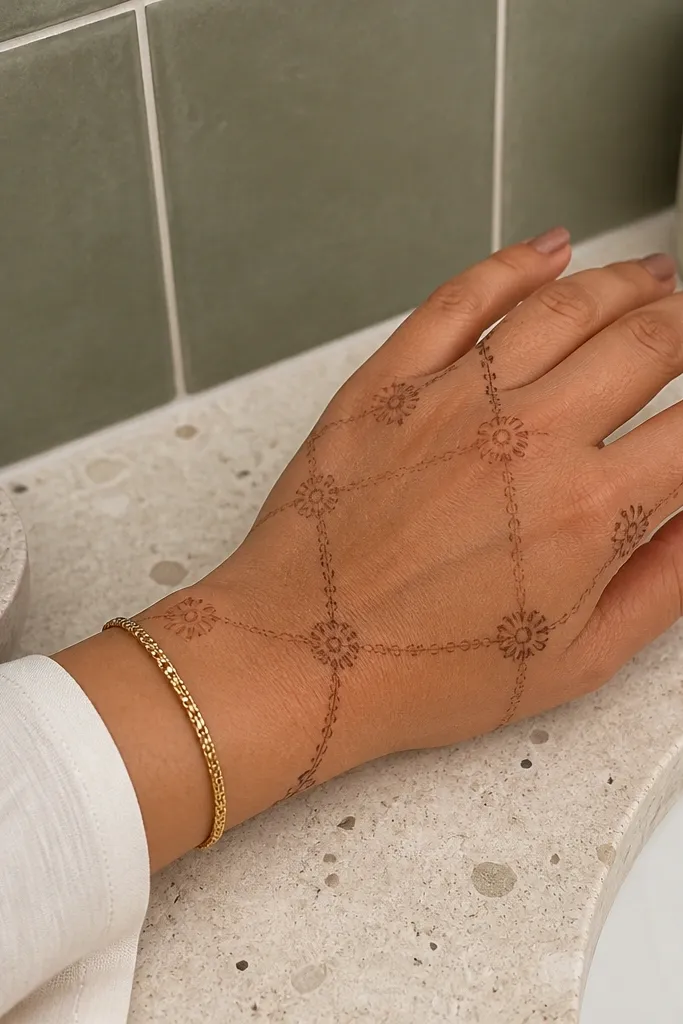
1. Slim Wrist Band With One Center Teardrop
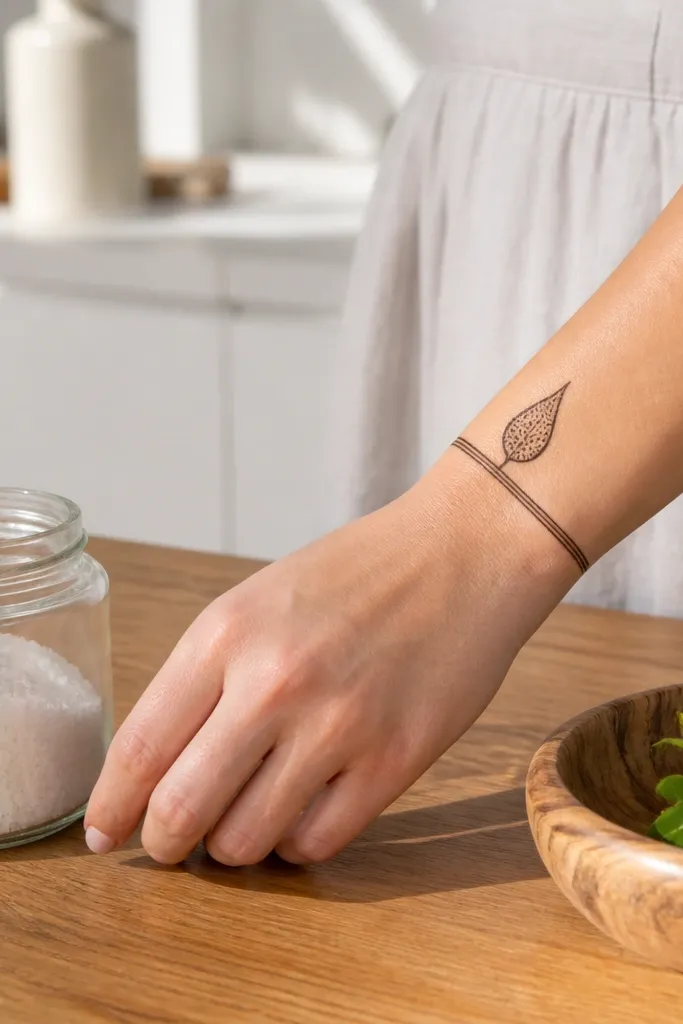
This design works because it concentrates attention in one place. A slim wrist band gives structure, while one clean teardrop in the center reads as Arabic without needing a full lattice. The teardrop should be tall and slightly tapered, with a few internal micro dots so it doesn’t look like a plain outline. Leave the rest of the back hand mostly open. It’s perfect for minimalist bridesmaids, Eid and Diwali dinners, or any day where you want mehndi that looks neat in photos.
Start by marking the wrist band with a light guide line and then fill it with a thin, even band of dots and short arcs. Next, draw one vertical teardrop centered on the back of the hand, keeping the sides symmetrical. Add 6-10 tiny dots inside the teardrop and a couple of short comma strokes at the base. Finish by adding a few micro ticks near the knuckles but stop before you cover the finger backs.
Pro tipLet the wrist band dry for 2-3 minutes before you draw the teardrop so the lines don’t bleed together.
AvoidAvoid thickening the teardrop outline — it ruins the minimalist balance.
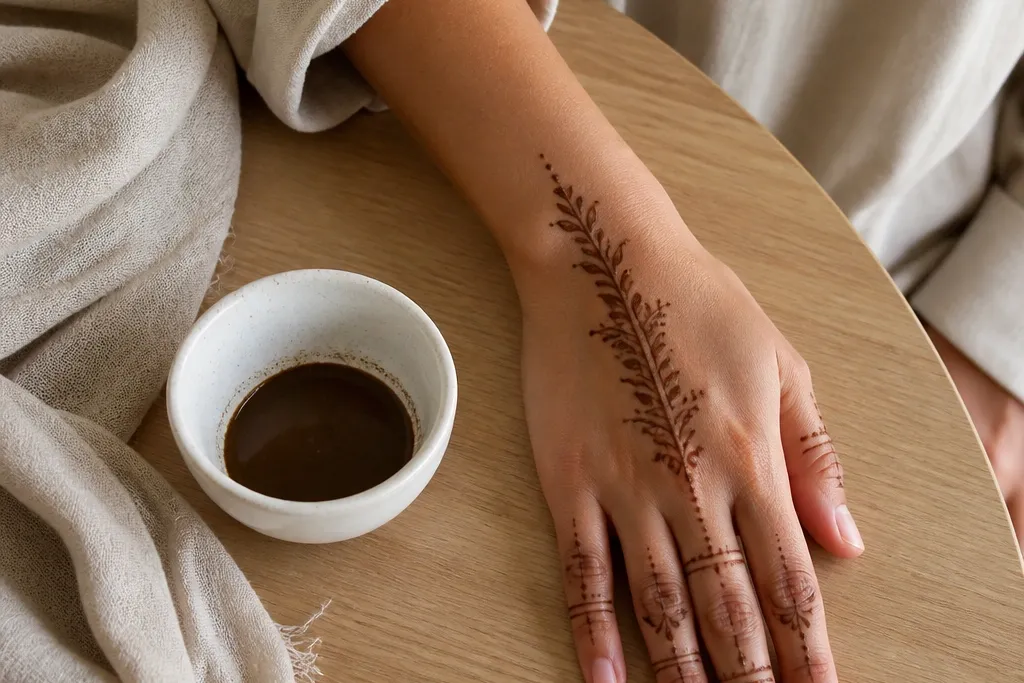
2. Knuckle Ring Line With Micro Petals
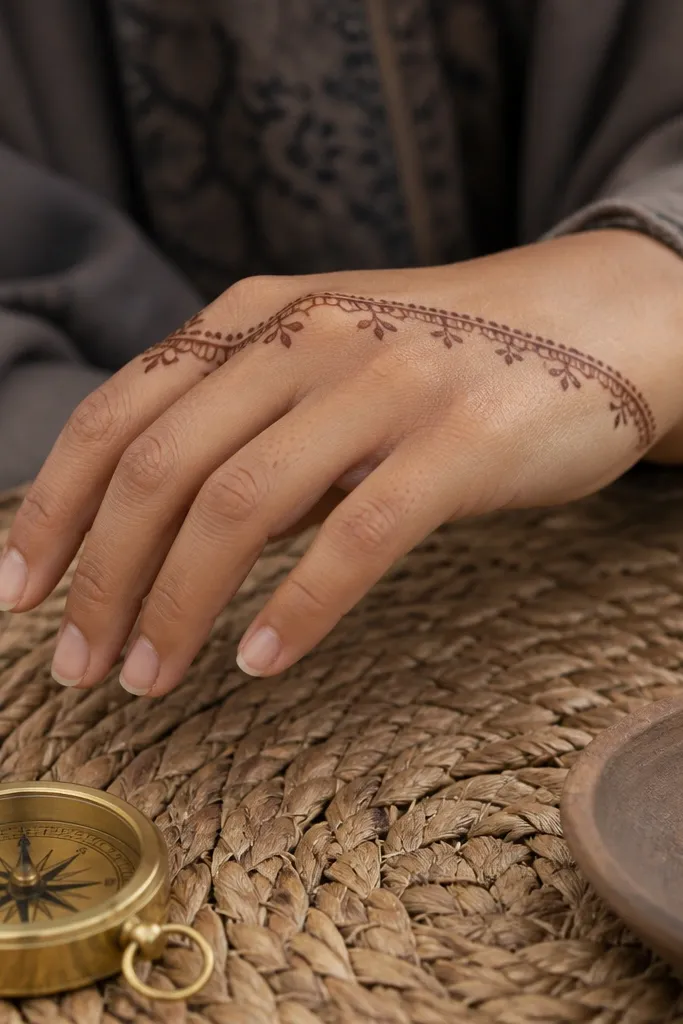
A knuckle ring line is the easiest way to make Arabic mehndi look intentional on the back hand. This layout places a single curved band across the knuckles, then adds tiny petals between finger bases. The petals should be small and repeated, not large and scattered. Because the center stays mostly open, the pattern looks modern and light. It’s a great pick if you want something holiday-friendly but still office-safe for the next day.
First, draw a smooth curved line across the knuckle area, following the natural curve of your fingers. Then add 4-6 tiny petals between the line segments, each petal made from two short curved strokes meeting at a point. Keep the petals the same size so the look stays minimalist. Finish with a few micro dots along the ring line ends and a light wrist mini band if you want extra symmetry.
Pro tipUse the cone tip like a pen — barely touch the skin for dots, and lift quickly for petals.
AvoidDon’t add extra vines — one ring line and small petals are enough.
3. Three-Leaf Center With Thin Side Arcs
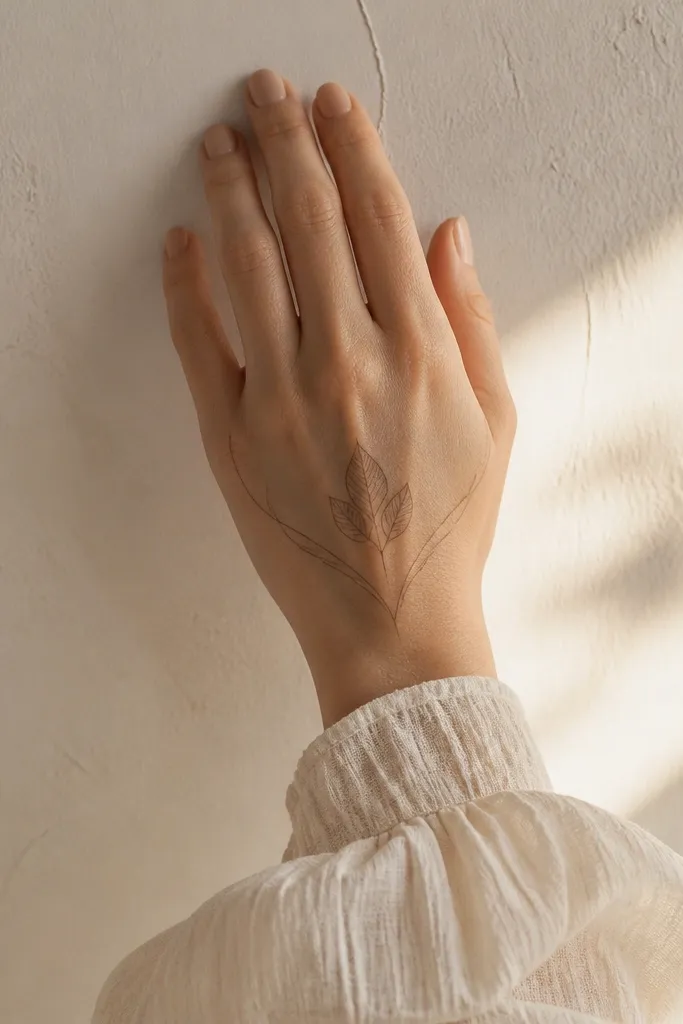
This design gives you Arabic leaf language without clutter. The center has three layered leaves stacked like a small fan, which reads clean even if your mehndi dries lighter. Thin side arcs connect toward the wrist and knuckles, giving flow but not coverage. Keep the arcs narrow and slightly curved so they don’t look like scribbles. This is a strong choice for modern minimalist Arabic back hand mehndi designs when you want it to look balanced from every angle.
Start by drawing three leaf shapes in the center: one upright in the middle and two angled on each side. Fill each leaf with 3-5 tiny dots or short hatch lines, but keep the fill sparse. Next, draw two thin arcs starting near the wrist and sweeping toward the center leaves, stopping before the fingers. Add a micro dot cluster at each arc end to make the pattern feel finished.
Draw leaf outlines first, then fill — it keeps your leaf edges crisp.
Avoid filling leaves heavily; thick fill makes the center look heavy.
4. Wrist Chevron Band With One Finger Tip Accent
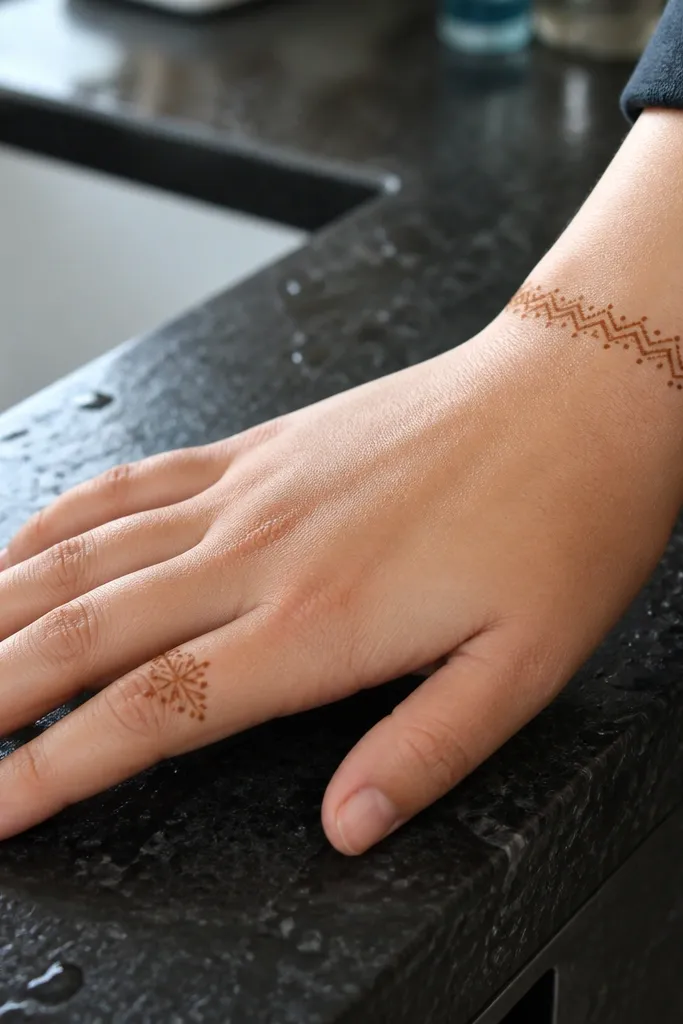
Chevron bands look sharp and modern, and Arabic mehndi loves structured zigzags when they’re slim. Here, the wrist chevrons carry the design, while a single small accent near one finger base keeps it minimalist. The rest of the hand stays open, so your skin tone and natural hand shape show through. This one is especially photogenic under warm lighting because the chevrons create a clean pattern rhythm.
Draw a slim wrist band and fill it with 10-14 chevrons, each chevron made from two short diagonal lines that meet. Keep the chevrons evenly spaced and aligned. Next, pick one finger axis and place a small almond or tiny leaf near the base of that finger on the back hand. Add 3-4 dots around the almond to echo the chevron geometry. Finish with 2 micro ticks at the knuckle area below the accent.
Pro tipMark the wrist band width with your finger first so the chevrons don’t drift.
AvoidDon’t repeat the accent on multiple fingers — it stops being minimalist.
5. Single Vertical Vine On Back Hand
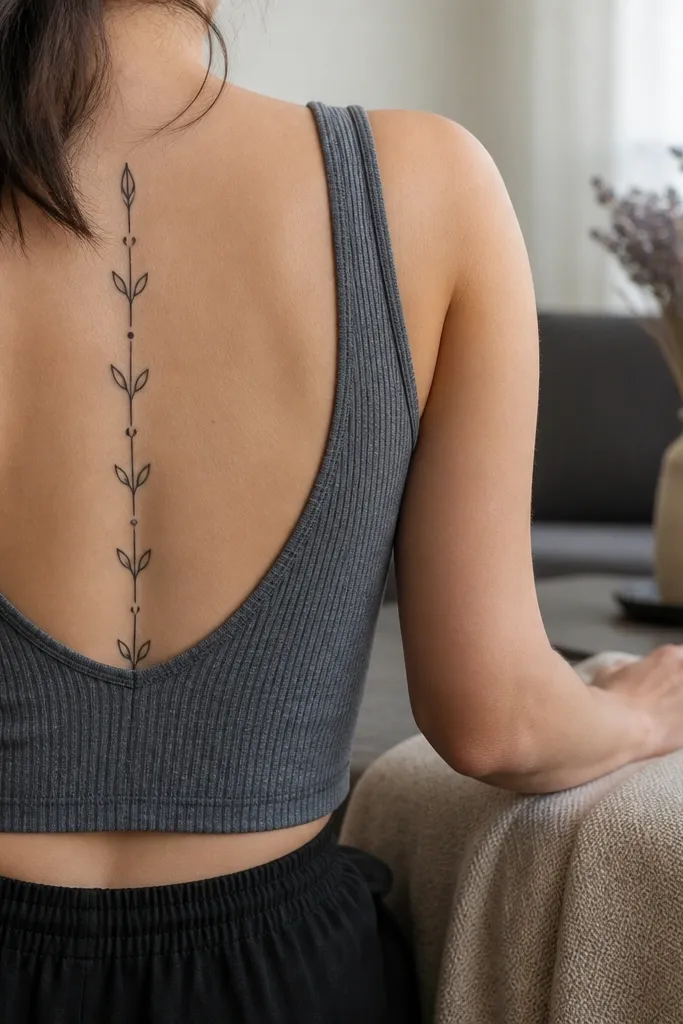
A single vertical vine is a minimalist Arabic trick that still looks Arabic. The vine gives direction, and leaf pairs placed along it create the classic mehndi rhythm. Because it’s one line, your hand doesn’t get overcrowded. Add small dots near each leaf pair for a finished look. This is ideal when you want a neat holiday design that still feels special without heavy filling.
Start by drawing a straight-ish vertical vine from the wrist toward the center of the back hand, keeping the line thin. Add leaf pairs on alternating sides, each leaf made from two curved strokes and a pointed tip. Place 5-7 leaf pairs total, spaced evenly. Add a small dot next to each leaf base, then stop — no branching.
If your vine wobbles, pause and re-touch only after the line firms up for 1-2 minutes.
Avoid branching into a second vine — it turns into a half-filled design.
6. Mini Fan Motif at Center With Dots
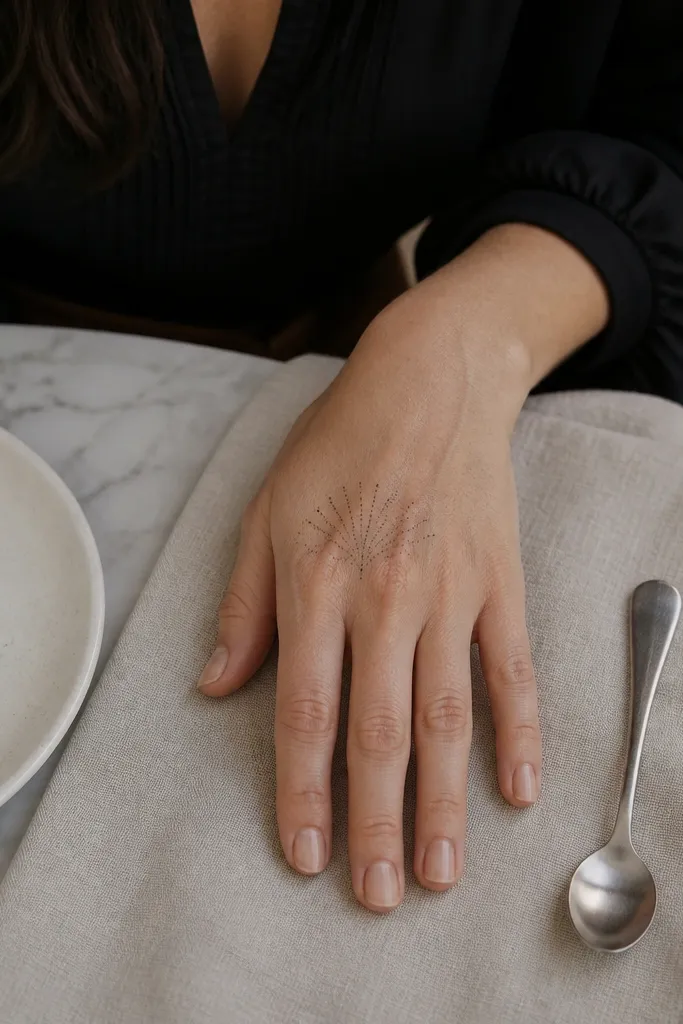
Fans are clean, symmetrical, and very photogenic. This design puts a mini fan motif in the center of the back hand and uses dots to keep it airy. The fan is made from 5-7 narrow leaf slats, each slat filled lightly with dots or tiny lines. You can add a thin wrist band if you want, but the fan already does the heavy lifting visually. It’s one of the simplest modern minimalist Arabic back hand mehndi designs that still looks intentional.
Draw a light guide circle or oval in the center. Inside it, sketch 5-7 narrow leaf slats radiating upward like a fan. Fill each slat with 2-3 dots, not full shading. Add a small arc of dots along the bottom of the fan and a few micro ticks near the knuckles. Keep the rest blank.
Pro tipUse consistent slat width by counting your slats before you draw the first one.
AvoidDon’t overfill the fan — heavy fill makes it look like a stain.
7. Wrist Band + Two Teardrop Corners
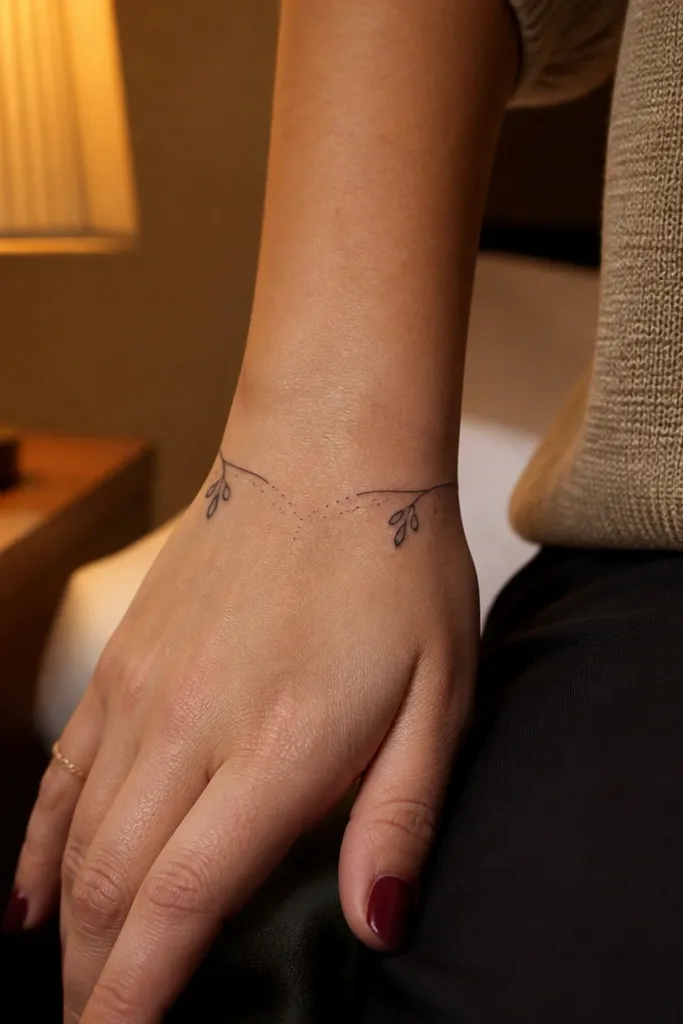
This layout uses corner teardrops to frame the back hand without filling the center. The wrist band gives a clean start, and two small teardrops on either side of the center create a balanced Arabic feel. Add micro dots along the teardrop stems, then stop. Because the center stays open, your hand looks light and modern in photos. It’s perfect for a quick holiday mehndi when you want something that still looks designed.
Start with a thin wrist band across the entire wrist width. Next, draw two small teardrops on the back hand corners — one leaning slightly toward the thumb side, the other toward the pinky side. Keep both teardrops the same height and add 4-6 dots inside each. Connect the teardrops to the wrist band with tiny comma strokes, then leave the middle blank.
Pro tipTrace the teardrop outline lightly first, then thicken only the outer line after it settles.
AvoidAvoid drawing vines into the center — framing is the point.
8. Finger Base Dots With Center Almond
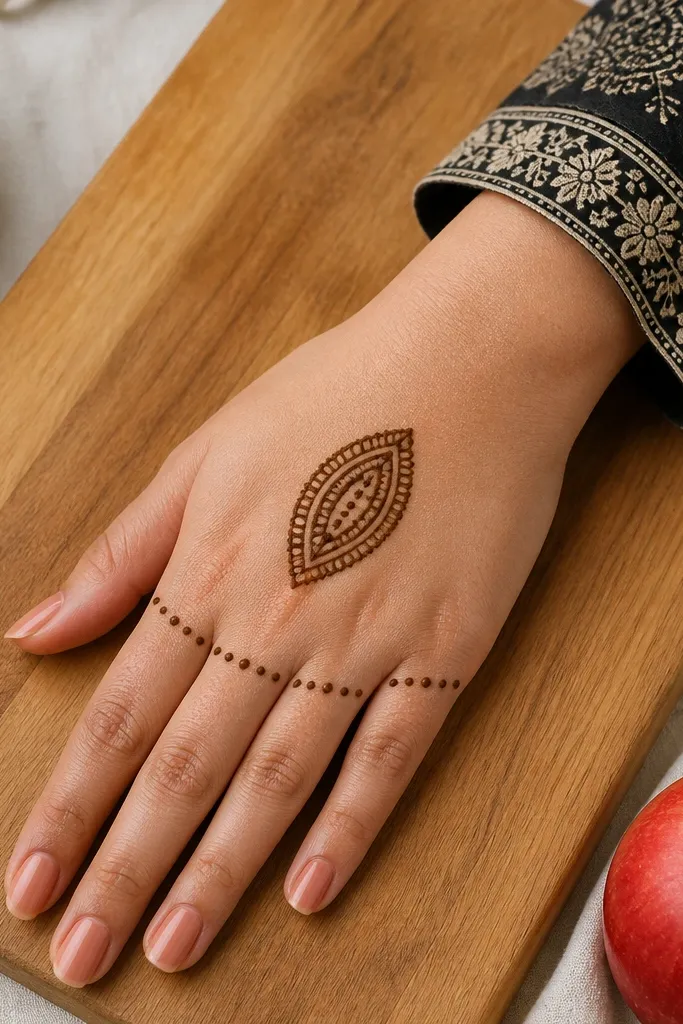
This design is minimalist but still detailed enough to read as mehndi. The finger base dots act like a subtle border, while one centered almond motif creates the main focus. The almond should be slightly horizontal or gently tilted, with a few internal dots so it doesn’t look empty. This style works well if you want a clean holiday look that doesn’t crowd your fingers or nails. It also hides small application mistakes because the motif is simple and symmetrical.
Draw one almond shape in the center of the back hand, keeping it narrow and clean. Fill the almond with 6-10 tiny dots arranged in two rows. Next, place dots at each finger base along the back of the knuckles area, about 2-3 dots per finger. Finally, add a very thin wrist line or skip it if you want extra airiness.
Keep dot size consistent by squeezing less paste and using the cone tip for short touches.
Avoid big blotchy dots — they break the delicate look.
9. Two Slim Side Arcs With No Center Fill
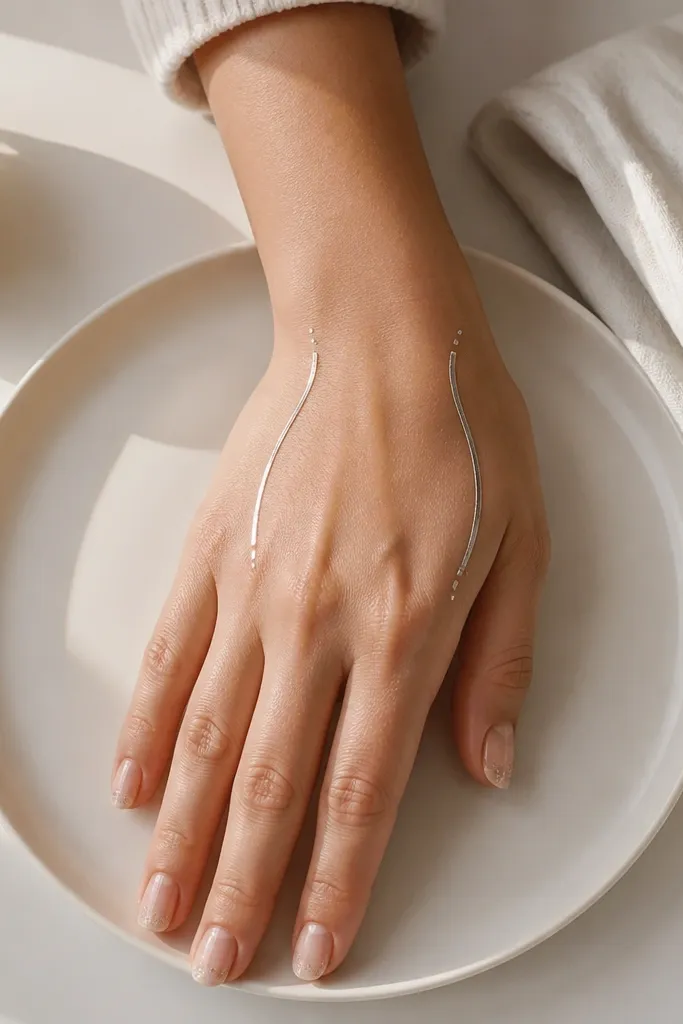
If you want the cleanest modern minimalist look, this one is it. Two slim arcs do all the visual work, creating an Arabic flow without any center filling. The arcs should be mirror images, with tiny dot clusters at their ends to finish the shape. Because the center stays blank, the design looks crisp even if your mehndi is lighter or dries patchy. It’s a safe choice for beginners who want something photogenic without heavy work.
Start by drawing a thin arc on one side from the wrist area toward the knuckle line, stopping before the finger backs. Mirror the arc on the other side with the same height and curvature. Add small dot clusters at both arc ends — 4-6 dots each cluster. If you want a little extra, add two micro commas between the arcs but keep the middle open.
Use a light pencil or soap mark to place arc endpoints so symmetry stays tight.
Don’t add a third arc — three lines make it look like unfinished practice.
10. Hanging Chain Motif From Wrist
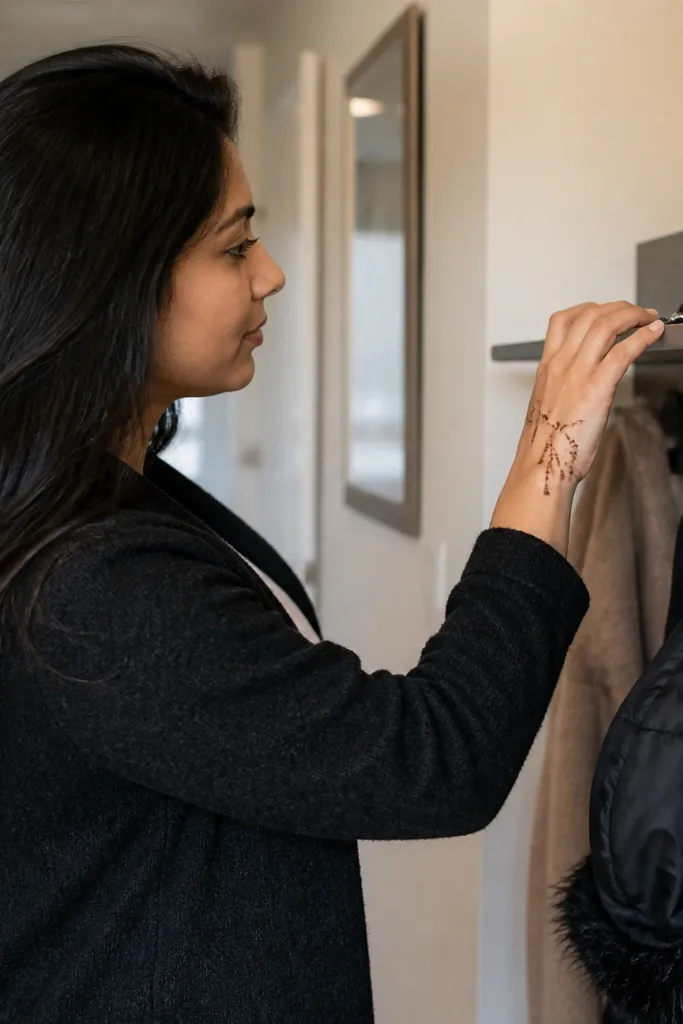
Arabic mehndi looks elegant when it uses chain links and loop language. This design starts at the wrist with a slim chain band and lets the chain hang downward in small, spaced loops. Each loop should be tiny and consistent, with dots inside every other loop for rhythm. The center stays mostly open, so the pattern stays modern and airy. It’s great for holiday events because it looks delicate and still stands out in photos.
Draw a thin wrist band line first. From the band, create 7-10 small loop links hanging down the center of the back hand, making each loop with a closed oval and a small inner dot in alternating loops. Keep the loops evenly spaced so it reads as chain, not random marks. Finish by adding a micro dot trail near the knuckles — stop before covering the finger bases.
Pro tipMake one sample loop on your paper first, then match that size on the hand.
AvoidAvoid uneven loop sizes — that’s what makes chain motifs look messy.
11. Center Starburst With Thin Outer Dots
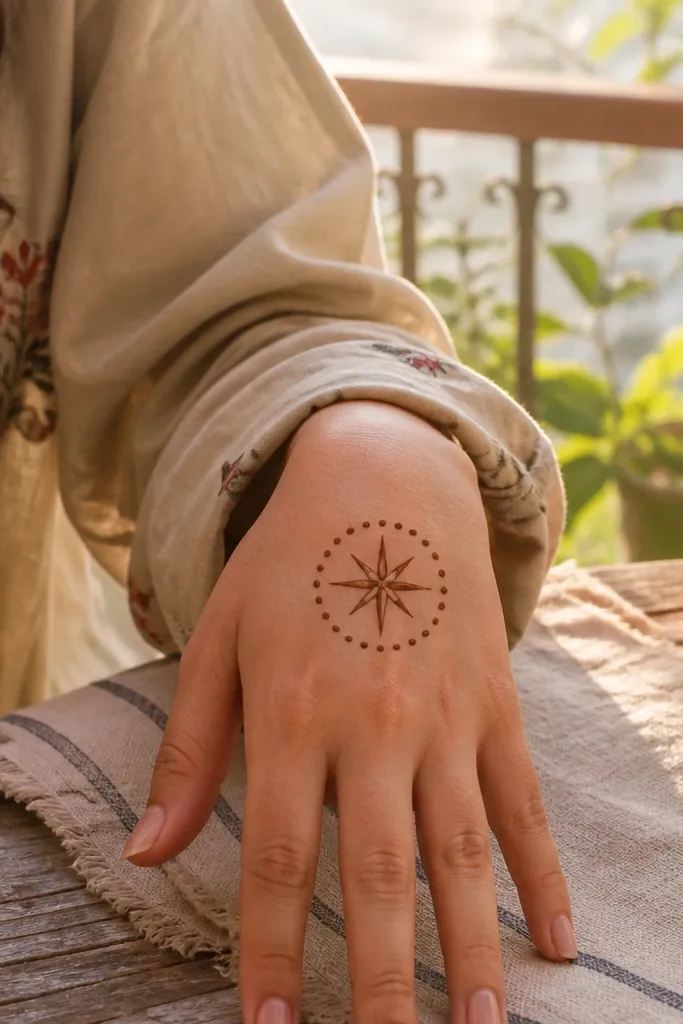
A starburst reads modern because it’s geometric, and Arabic mehndi can absolutely use that shape in a minimalist way. Put a small starburst in the center of the back hand — 6-8 rays — then surround it with a thin ring of dots. The rays should be narrow lines with tiny pointed ends, not thick spears. This keeps it clean and photogenic. Add a very thin wrist band only if you want; the starburst already frames the hand.
Draw a small dot center where the starburst will start. Create 6-8 rays radiating outward with thin strokes, leaving a little gap between rays. Then place a ring of dots around the outer tips, about 12-16 dots total. Add two tiny comma marks near the wrist line to balance the layout. Keep everything else blank.
Count rays before you start so you don’t end up with uneven angles.
Avoid thick rays — they flatten the starburst into a blob.
12. Feather Leaf Stack Near Wrist
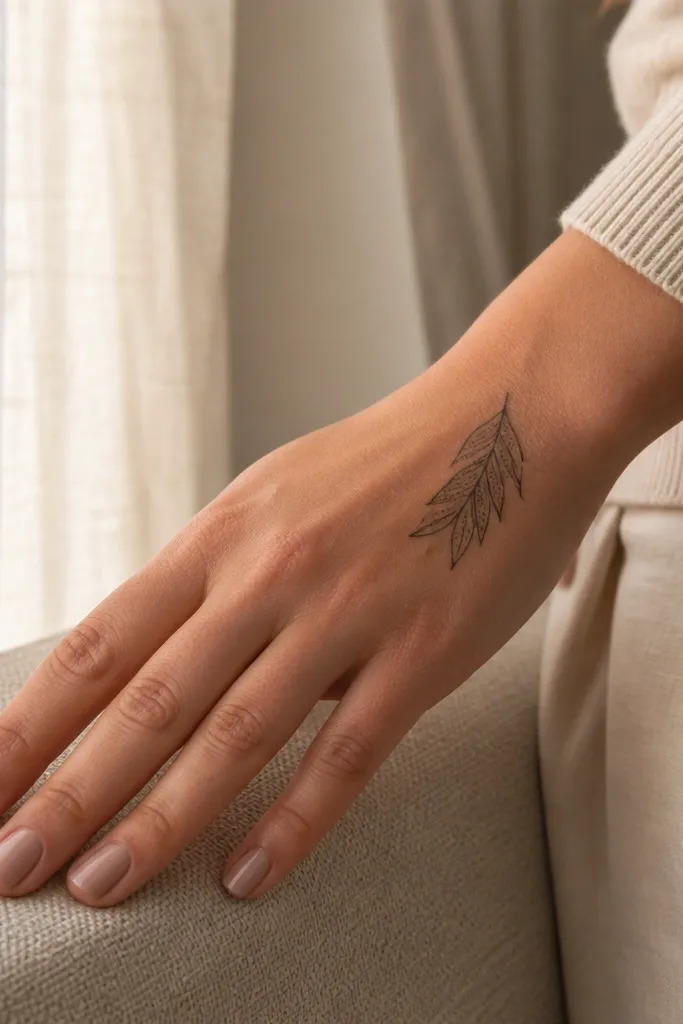
Feather leaf stacks look airy, modern, and very Arabic because they mimic layered petals without heavy fill. Place the stack near the wrist on one side of the center, then keep the rest blank. Each leaf should be narrow, slightly angled, and made from a clean outline with light dots or short lines inside. The result is a crisp holiday look that doesn’t overpower your hand shape. It’s also a good choice if you want something that feels intentional but still quick to apply.
Start with a short curved stem line near the wrist, angled toward the center. Build 5-7 feather leaves along the stem, each leaf made from two curved strokes meeting at a pointed tip. Fill each leaf lightly with 2-3 dots near the center line. Add 8-12 tiny dots around the stack like a soft halo. Stop at the mid-back hand so the center stays open.
Keep leaf tips aligned to the same direction for a polished feather look.
Don’t spread leaves too far — the stack should feel tight.
13. Wrist Double Band With Single Knuckle Dot Row

Double bands give a clean, fashion-mehndi look. Here, you draw two slim wrist lines with a little gap in between, then add one dot row across the knuckles to echo the structure. This is modern minimalist Arabic styling because it uses repeating rhythm instead of dense fill. The back hand stays open, so the design reads light and sharp. It’s a great pick for short sessions because it’s mostly bands and one repeating element.
Draw the first thin wrist band line, then add the second line 3-4 mm above it. Connect the two lines with tiny micro dots at 5-7 points so it looks intentional. Next, draw a curved row of dots across the knuckle area, with 2-3 dots per finger gap. Add a few dots at the ends of the knuckle row and keep the center blank.
Pro tipUse the same dot size on both bands and knuckles for a unified look.
AvoidAvoid thick bands — double lines should stay delicate.
14. Minimal Arabic Lattice Corners
This is how you get Arabic lattice without the heavy full-cover feel. Keep lattice only in the corners of the back hand — near the wrist edges and near the knuckle sides — while leaving the center open. The lattice should be small squares made from two crossing lines, with dots at intersections. Add a thin wrist band to anchor it. It’s photogenic because the pattern frames the hand shape and creates a crisp grid effect.
Start by drawing a thin wrist band across the wrist. Then create lattice squares in two corner zones: one near the thumb-side knuckles and one near the pinky-side knuckles. For each corner, draw 5-7 small squares using crossing lines, and put one dot at each intersection. Add a few micro dots around the lattice to soften edges. Leave the center blank.
Pro tipPlan square size first: aim for each square to be about the width of your little fingernail line.
AvoidDon’t connect the corners into a full grid — corners are the minimalist move.
15. Arabic Leaf Outline With Empty Inside
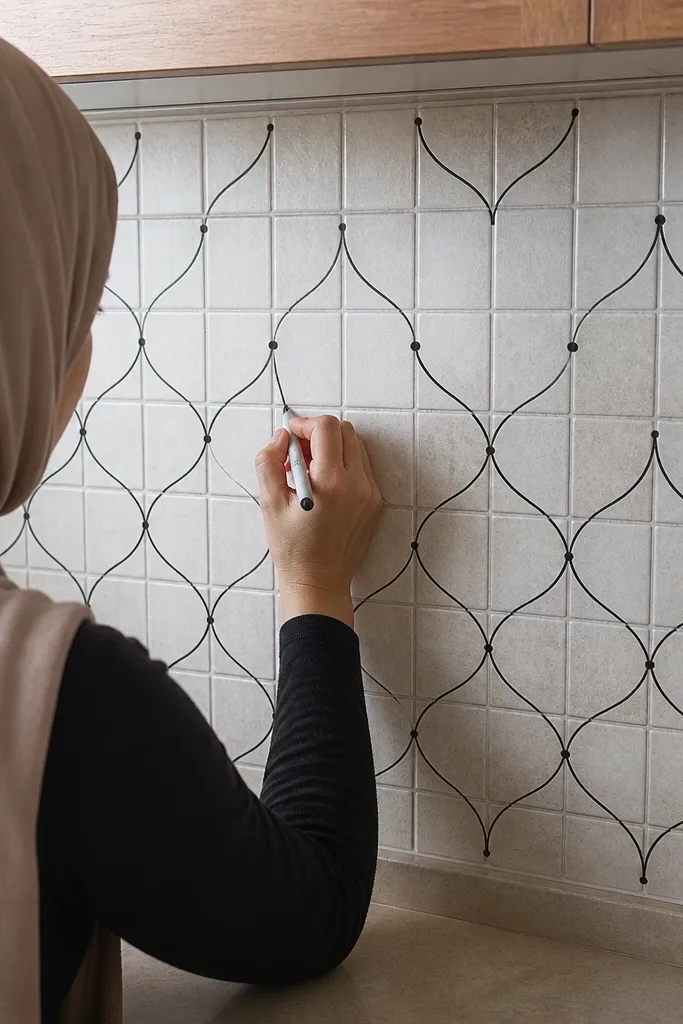
Outline-only designs look modern when the outlines are clean and consistent. This one uses Arabic leaf shapes across the back hand but keeps the inside empty so the hand stays airy. Add tiny dots at each leaf tip to give it that finished Arabic touch. Because there’s no fill, it’s also forgiving for beginners who sometimes over-darken. This looks great for holiday outfits where you want mehndi to match a clean outfit silhouette.
Draw 6-8 leaf outlines across the back hand in a gentle arc, keeping the leaves narrow. Don’t fill the inside — just keep the outlines crisp. Place 1 dot at each leaf tip and 2-3 tiny dots along the base of the leaf arc. Add a thin wrist line to frame the top, then stop before the fingers. Keep spacing consistent between leaves.
Pro tipIf your line breaks, redraw on top after 1-2 minutes instead of thickening immediately.
AvoidAvoid random leaf sizes — outline-only needs uniformity.
16. Center Column of Dots With Two Side Petals
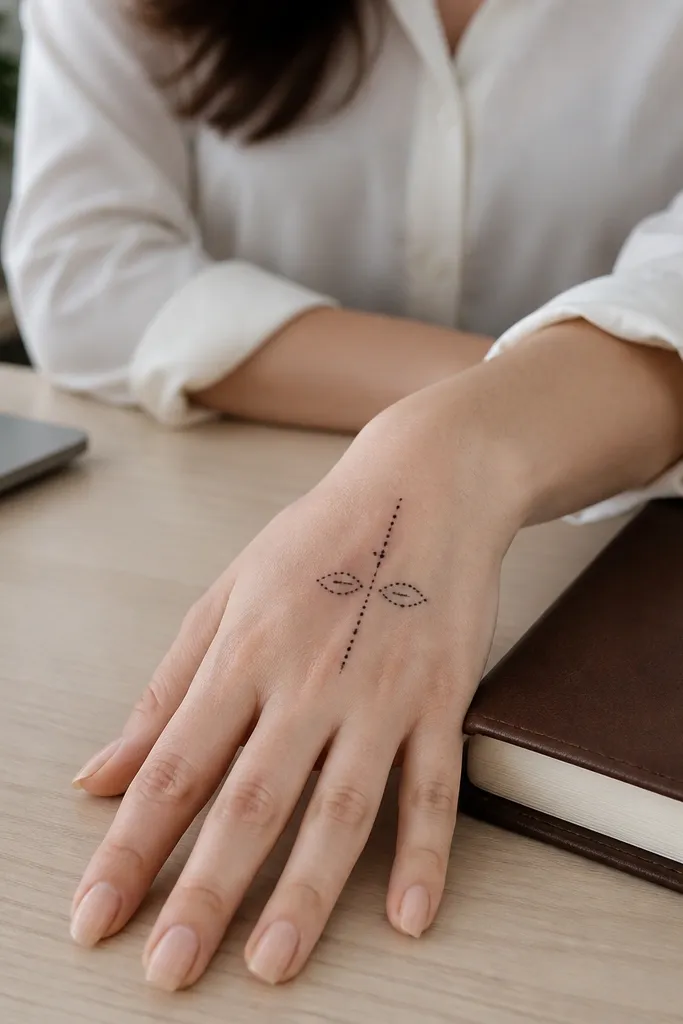
This design is minimalist Arabic in its purest form: a dot column gives height, and two side petals give character. Put the dot column in the center of the back hand, then add one small petal on each side at the mid-height. Keep the petals small and pointed, with dots inside. The result is clean, modern, and easy to read in photos. It also works well if you want mehndi that dries lighter but still looks intentional.
Start by drawing a vertical line guide in the center, then place 10-14 dots along it from wrist toward mid-hand. At the middle dot, draw two small symmetrical petals — one on each side — shaped like an almond with pointed ends. Add 3-5 dots inside each petal. Finish with a micro dot cluster at the top of the dot column and a thin wrist line if you want a complete frame.
Pro tipUse a steady squeeze and keep dot spacing equal so the column looks planned.
AvoidDon’t add extra swirls — extra shapes break the minimalist rhythm.
17. Wrist Mini Mandala With Blank Back Hand
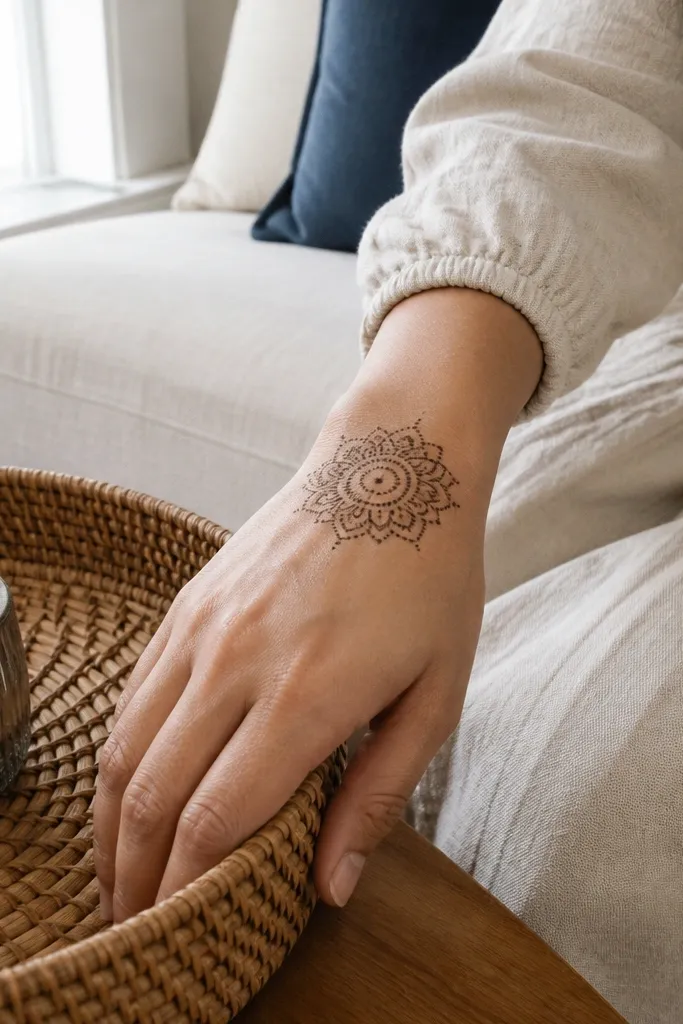
Mandala-style circles look festive without turning into full coverage. This one places a mini mandala on the wrist area and keeps the rest of the back hand blank. The mandala can be tiny: a ring of dots, 6-8 petal arcs, and a few inner lines. It feels Arabic because the petals and dot ring are classic mehndi elements. This is a smart holiday choice when you want a focal point that looks good even if you can’t spend time shading large areas.
Draw a small circle or oval near the wrist, about the size of two stacked rings. Make an outer ring of dots around it. Inside, add 6-8 petal arcs radiating from the center, and connect a few arcs with short lines. Add 1-2 small dot clusters between petals for balance. Stop there — no center back hand fill.
If your circle wobbles, draw it lightly first, then thicken only after it dries slightly.
Avoid enlarging the mandala too much — big circles make the minimalist look heavy.
18. Knuckle Feathers With One Downward Accent
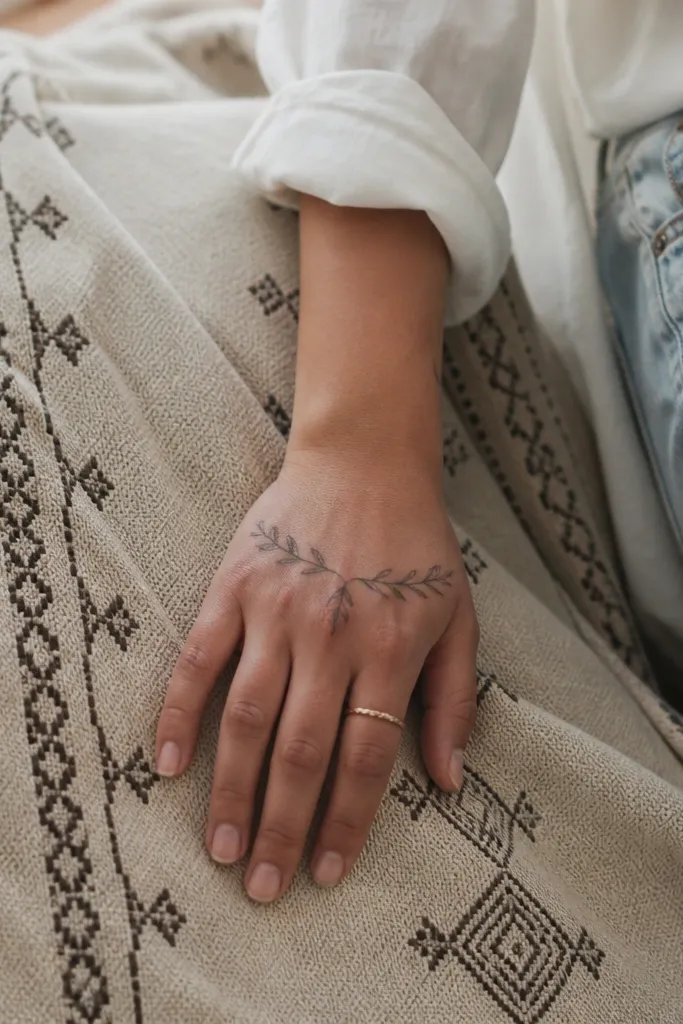
Feathers at the knuckles give a modern edge and keep focus near where your hand shows most in photos. This design places small feather leaves along the knuckle line, then adds one downward accent from the center. The center accent can be a tiny leaf stack or a short vine with two leaves. Leave the rest open. It looks good for festive nights because it frames the fingers without covering them fully.
Start by drawing a light curved line across the knuckles. On that line, add 6-8 small feather leaves, each leaf made from a pointed outline and 2-3 dots inside. Next, from the center of the knuckle line, draw one short downward accent — either a two-leaf stack or a thin vine with two tiny leaves. Finish with a slim wrist line to connect the look and stop before the finger backs.
Pro tipKeep feather leaves short so they don’t overlap your finger knuckles.
AvoidAvoid long vines — keep the accent short for minimalist balance.
19. Slim Side V Wrap Around Thumb Base
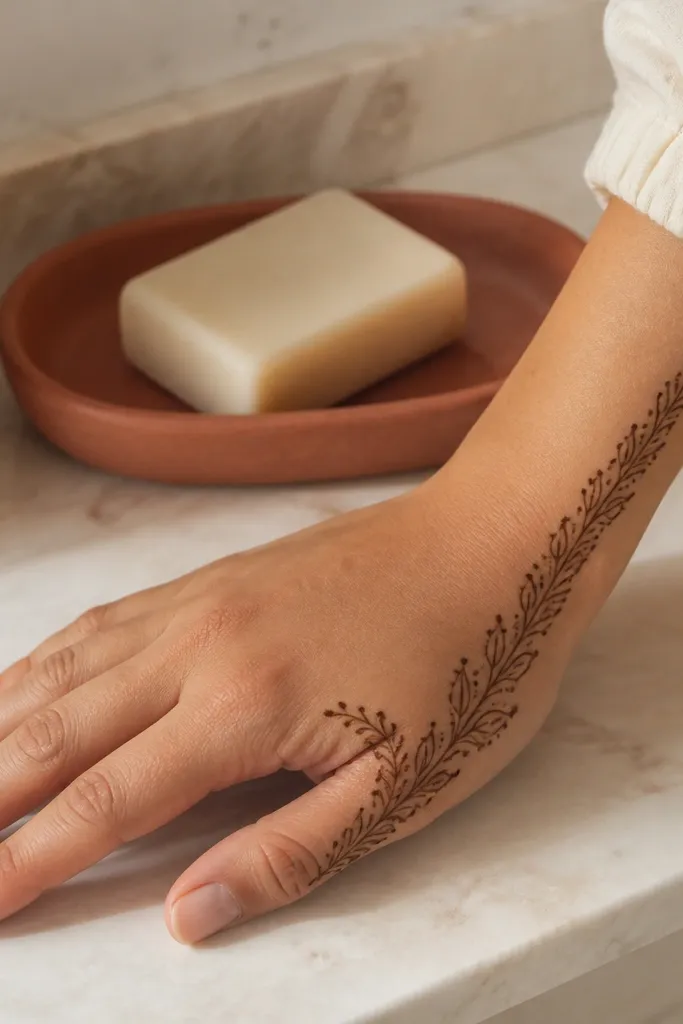
Thumb-side mehndi often looks best when it’s sharp and directional. This design wraps in a slim V shape around the thumb base and connects toward the wrist with tiny dots. It’s Arabic in feeling because it uses flowing curves and leaf-like points, but it stays minimalist because the pattern is confined to one side. This is a great choice for holiday looks when you want something that shows up in close shots without covering the whole back hand.
Start with a V shape at the thumb base, using two thin strokes that meet at a point. Extend each arm of the V slightly toward the wrist, keeping the lines straight-to-curved. Add 4-7 tiny dots along the inside of the V and one small leaf tip at the bottom point. If you want balance, add a single micro comma near the opposite knuckle side. Keep the center blank.
Pro tipUse the side of the cone tip for the V stroke — it keeps it narrow and smooth.
AvoidAvoid drawing the V too wide — width kills the minimalist look.
20. Wrist Dot Halo With One Curved Line
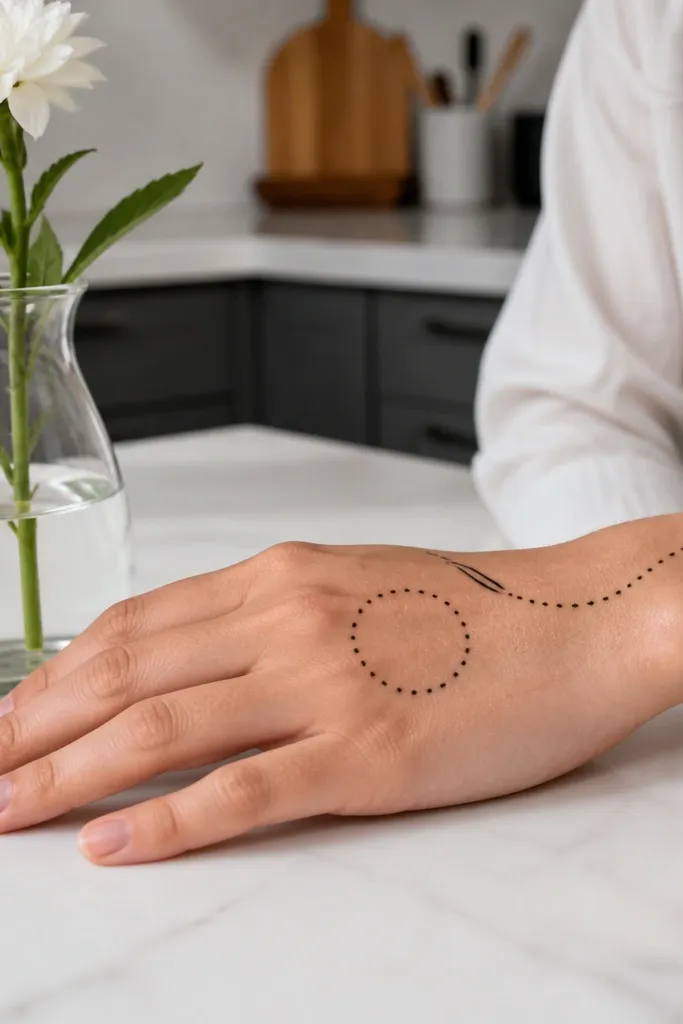
This is a clean, graphic design that looks modern in any lighting. The wrist dot halo gives a festive ring effect, and one curved line sweeps across the back hand to create movement. Add a few micro dots along the curved line for texture, but keep the center empty. It’s minimalist Arabic because the curve mimics Arabic flow and the dots add the classic finish. Great for holiday dinners when you want mehndi that looks stylish, not heavy.
Draw a dot halo around the wrist — a ring of dots with consistent spacing, about 14-20 dots. Then draw one thin curved line starting from one side of the halo and sweeping toward the center of the back hand. Add 6-10 micro dots spaced along this curved line. Stop the line before it reaches the finger backs. Optionally add a tiny dot cluster at the end of the curve.
Pro tipIf the dots look uneven, re-check your cone pressure — most unevenness comes from squeezing too hard intermittently.
AvoidAvoid adding a second curve — one sweep keeps it graphic.